
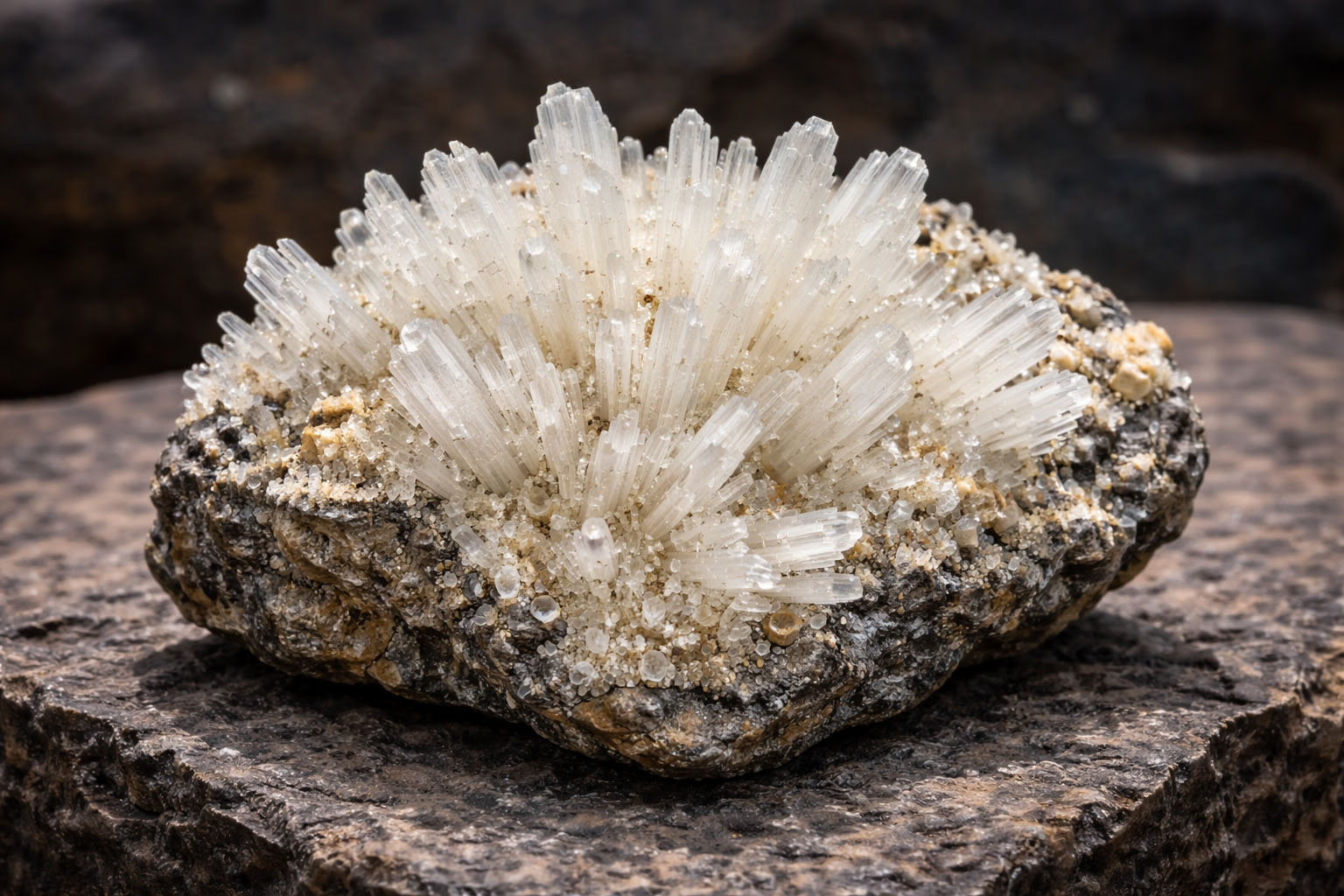
 Natrolite Mineral Overview
- Mineral name: Natrolite
- Mineral class: Silicate (tectosilicate, zeolite group)
- Chemical formula: Na₂Al₂Si₃O₁₀·2H₂O
- Crystal system: Orthorhombic
- Mohs hardness: 5–5.5
- Color range: Colorless, white, gray, pale yellow
- Luster: Vitreous to silky
- Streak: White
- Cleavage: Perfect
- Fracture: Uneven to splintery
- Specific gravity: Approximately 2.2–2.3
- Transparency: Transparent to translucent
- Common locations: United States, India, Iceland, Italy, Russia
- Uses: Collector mineral, industrial zeolite applications
- Similar minerals: Mesolite, scolecite, stilbite
Naming and Classification
Natrolite is a sodium-rich zeolite mineral, part of a group known for their hydrated framework structures and ability to exchange ions.
Its name comes from:
- natron = sodium
- lithos = stone
This reflects its sodium content and mineral nature.
Physical and Optical Characteristics
Natrolite typically occurs as:
- Slender, needle-like (acicular) crystals
- Radiating sprays or fan-shaped aggregates
- Fibrous masses
These crystals often form delicate, starburst-like clusters.
Its color is usually colorless to white, though it may appear:
- Pale yellow
- Light gray
The luster is vitreous on crystal faces and silky in fibrous aggregates.
With a Mohs hardness of 5–5.5, natrolite is moderately hard.
Crystal Habit (Key Feature)
One of natrolite’s most recognizable traits:
- Fine, needle-like crystals forming radiating sprays
This distinguishes it from many other zeolites, which tend to form more blocky or tabular crystals.
Chemical Composition and Structure
Natrolite is composed of:
- Sodium (Na)
- Aluminum (Al)
- Silicon (Si)
- Water (H₂O)
It has a three-dimensional framework structure with:
- Channels that contain water molecules
- Open spaces that allow ion exchange
This porous structure is characteristic of zeolites.
Formation and Geological Occurrence
Natrolite forms in low-temperature environments, especially in:
Volcanic Rocks
- Cavities in basalt
- Vesicles filled by mineral-rich fluids
Hydrothermal Systems
- Deposited from mineral-bearing solutions
Typical formation conditions include:
- Cooling volcanic environments
- Interaction of fluids with aluminum- and silica-rich rocks
It is commonly associated with:
- Other zeolites (mesolite, scolecite, stilbite)
- Calcite
- Quartz
Common Locations
Natrolite is found in many regions worldwide:
- United States: New Jersey (classic locality), Oregon
- India: Maharashtra (large and well-formed specimens)
- Iceland: Volcanic क्षेत्रों
- Italy and Russia: Additional occurrences
Indian specimens are especially famous for large crystal sprays.
Uses and Practical Significance
Natrolite is used primarily for:
Collector Specimens
- Highly valued for delicate crystal sprays
- Popular among zeolite collectors
Industrial Zeolite Applications
- Ion exchange
- Water purification
- Catalysis (less common than synthetic zeolites)
Similar and Related Minerals
Natrolite can resemble:
- Mesolite: More flexible fibers and different composition
- Scolecite: Often forms thicker, radiating crystals
- Stilbite: More tabular and less needle-like
Crystal habit is key for distinguishing natrolite.
Identification Notes for Collectors
- Look for fine, needle-like radiating crystals
- Note white to colorless appearance
- Check moderate hardness (5–5.5)
- Observe silky to vitreous luster
- Consider association with basalt cavities and other zeolites
Natrolite is a zeolite mineral, recognized for its delicate needle-like crystal sprays and porous structure, making it both visually striking and scientifically important within the zeolite group.