
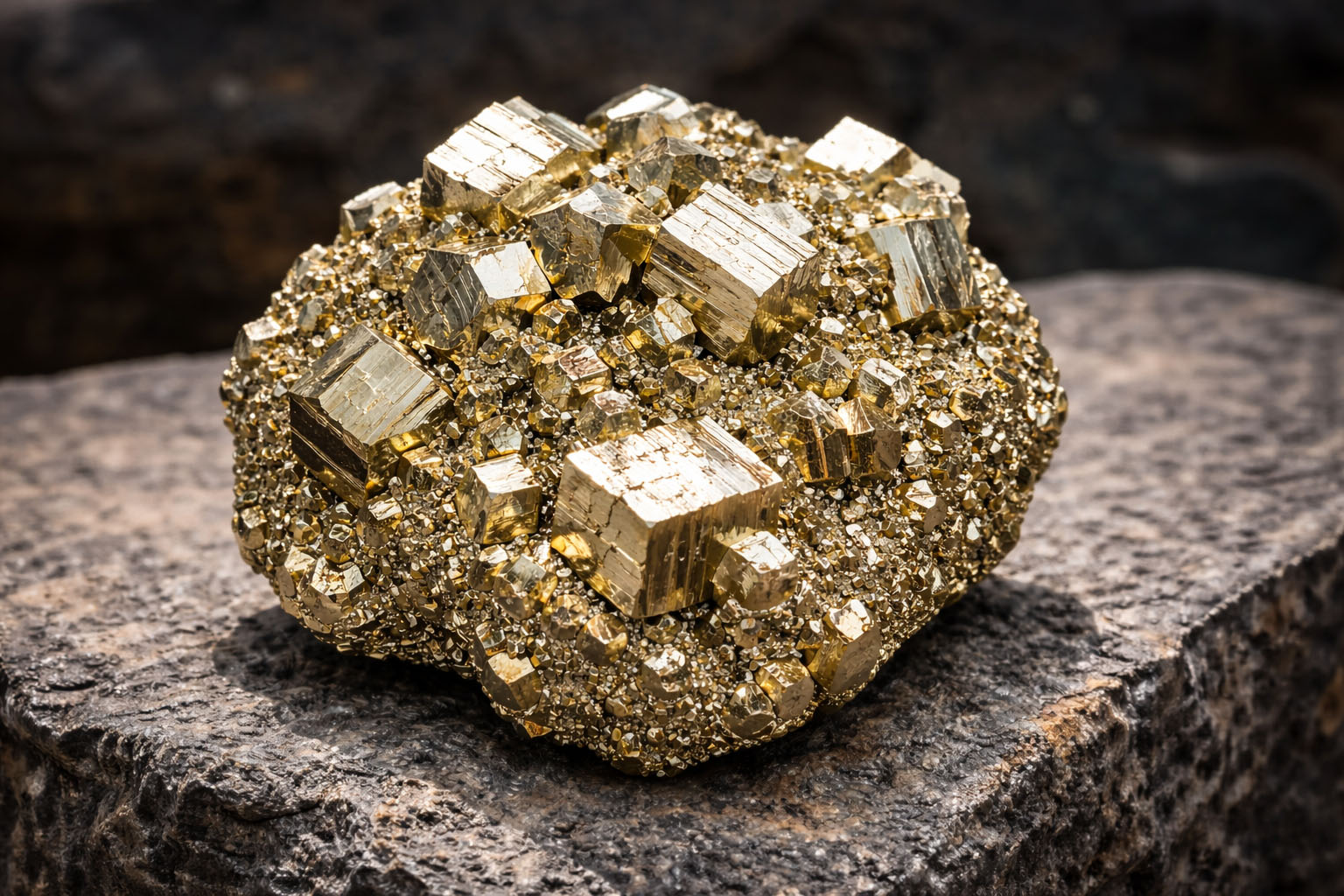
 Pyrite Mineral Overview
- Mineral name: Pyrite
- Mineral class: Sulfide
- Chemical formula: FeS₂ (iron disulfide)
- Crystal system: Isometric (cubic)
- Mohs hardness: 6–6.5
- Color range: Pale brass-yellow (“gold-like”)
- Luster: Metallic
- Streak: Greenish-black to brownish-black
- Cleavage: Poor to indistinct
- Fracture: Conchoidal to uneven
- Specific gravity: Approximately 4.9–5.2
- Transparency: Opaque
- Common locations: Worldwide
- Uses: Sulfur source (historically), collector mineral, industrial applications
- Similar minerals: Gold, chalcopyrite, marcasite
Naming and Classification
Pyrite is one of the most well-known minerals, often called “fool’s gold” because of its resemblance to real gold.
Its name comes from the Greek pyr meaning “fire,” because it can produce sparks when struck against metal or stone.
It is one of the most common sulfide minerals and occurs in a wide range of geological environments.
Physical and Optical Characteristics
Pyrite is famous for its bright metallic luster and brassy yellow color, which gives it a gold-like appearance.
It commonly forms:
- Cubic crystals (most iconic form)
- Pyritohedrons (12-faced crystals)
- Massive or granular aggregates
Crystals often have:
- Sharp edges
- Striated faces (fine parallel lines)
With a hardness of 6–6.5, pyrite is significantly harder than gold, making it easy to distinguish by scratch testing.
Gold vs. Pyrite (Key Differences)
Pyrite is often mistaken for gold, but key differences include:
- Color: Pyrite is paler and more brassy
- Hardness: Pyrite is much harder
- Streak: Pyrite has a dark streak; gold has a yellow streak
- Shape: Pyrite forms cubes; gold forms irregular nuggets
Chemical Composition and Properties
Pyrite is composed of:
- Iron (Fe)
- Sulfur (S₂ units)
It is chemically stable under many conditions but can oxidize when exposed to moisture and air, forming:
- Iron oxides (rust-like material)
- Sulfuric acid (in certain environments)
Formation and Geological Occurrence
Pyrite forms in a wide variety of environments:
Sedimentary
- Common in shale and coal deposits
- Forms as nodules or concretions
Hydrothermal
- Occurs in mineral veins with metals like copper, lead, and zinc
Metamorphic
- Found in schists and other metamorphic rocks
It is commonly associated with:
- Quartz
- Calcite
- Chalcopyrite
- Sphalerite
Common Locations
Pyrite is found worldwide, with notable sources including:
- Spain: Navajún (famous for perfect cubes)
- Peru: Large crystal specimens
- United States: Colorado, Illinois
- Italy: Elba Island
It is one of the most abundant sulfide minerals on Earth.
Uses and Practical Significance
Pyrite has had several important uses:
Historical Uses
- Source of sulfur for sulfuric acid production
- Used to create sparks for early fire-starting tools
Industrial Uses
- Sulfur source (now largely replaced by other methods)
Collector and Decorative
- Popular mineral specimens
- Jewelry and decorative pieces
Environmental Considerations
Pyrite can play a role in environmental processes:
- Oxidation can produce acid mine drainage
- Important in studying geochemistry and mining impacts
Similar and Related Minerals
Pyrite can resemble:
- Gold: Softer, more yellow, no crystal faces
- Chalcopyrite: More yellow with iridescent tarnish
- Marcasite: Same composition but different crystal structure
Crystal shape and hardness are key distinguishing features.
Identification Notes for Collectors
- Look for brassy yellow metallic cubes
- Check hardness (scratches glass)
- Observe greenish-black streak
- Note striations on crystal faces
- Compare weight and malleability vs. gold
Pyrite is an iron sulfide mineral, recognized for its metallic luster, cubic crystals, and resemblance to gold, making it one of the most iconic and widely recognized minerals in the world.