
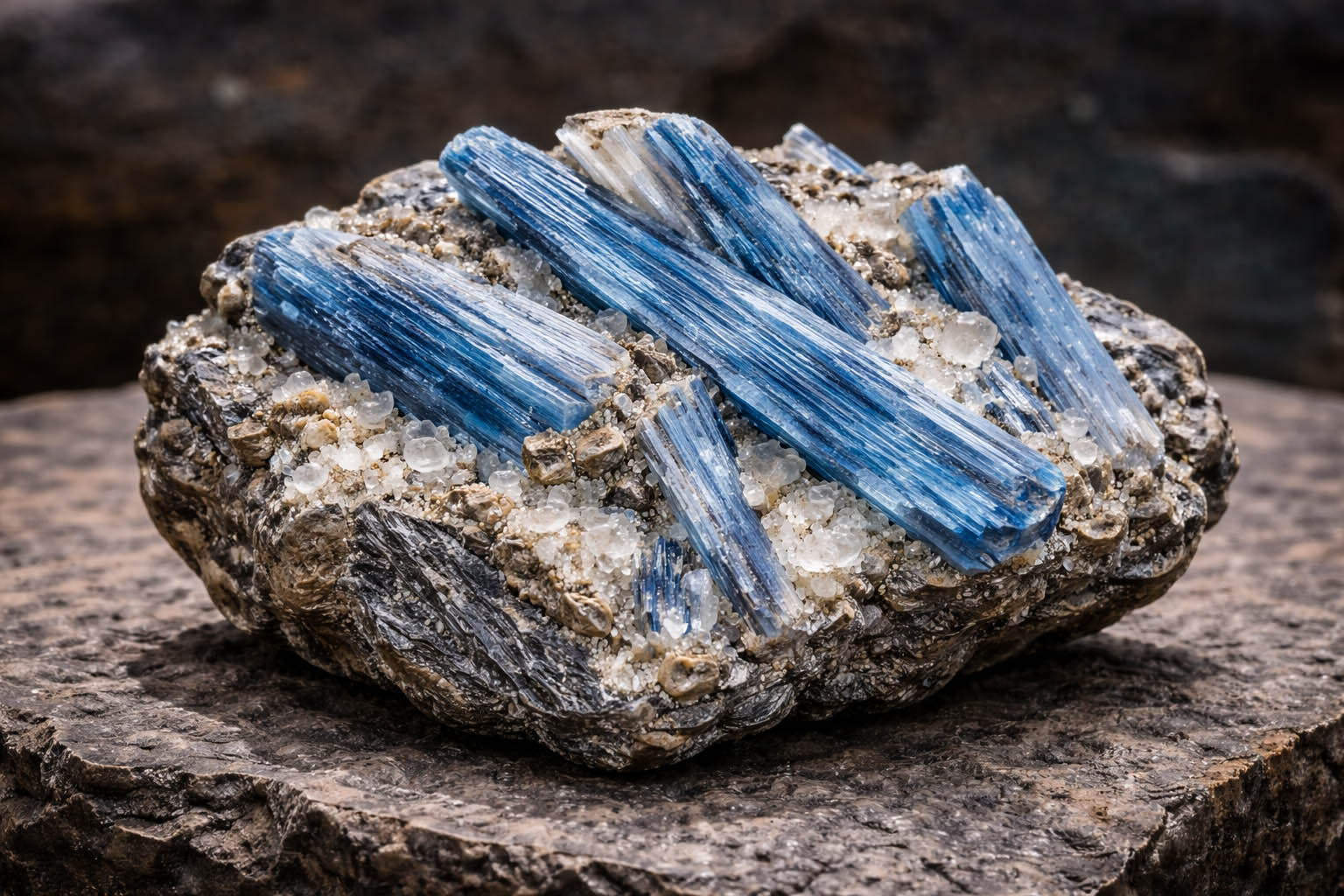
 Kyanite Mineral Overview
- Mineral name: Kyanite
- Mineral class: Silicate (nesosilicate)
- Chemical formula: Al₂SiO₅
- Crystal system: Triclinic
- Mohs hardness: 4.5–5 (parallel to length), 6.5–7 (across width)
- Color range: Blue, blue-gray, white, green, black, colorless
- Luster: Vitreous to pearly
- Streak: White
- Cleavage: Perfect (one direction)
- Fracture: Uneven to splintery
- Specific gravity: Approximately 3.5–3.7
- Transparency: Transparent to translucent
- Common locations: Brazil, Nepal, United States, Switzerland, India
- Uses: Refractory materials, gemstones
- Similar minerals: Andalusite, sillimanite
Naming and Classification
Kyanite is an aluminum silicate mineral, one of three polymorphs with the same chemical formula:
- Kyanite
- Andalusite
- Sillimanite
These minerals differ in structure based on pressure and temperature conditions.
The name comes from the Greek kyanos, meaning “blue,” referring to its most common color.
Physical and Optical Characteristics
Kyanite typically occurs as:
- Bladed or elongated crystals
- Fibrous or columnar aggregates
Its most recognizable form is:
- Long, flat, blade-like crystals
Color is usually blue, but can also be:
- Blue-gray
- White or colorless
- Green or black (less common)
The luster is vitreous, with a pearly sheen on cleavage surfaces.
Variable Hardness (Key Feature)
Kyanite is famous for its anisotropic hardness, meaning:
- Softer along the length (4.5–5)
- Harder across the width (6.5–7)
This unusual property is a key identification feature.
Chemical Composition and Structure
Kyanite is composed of:
- Aluminum (Al)
- Silicon (Si)
- Oxygen (O)
It has a nesosilicate structure, with:
- Isolated silica tetrahedra
- Chains of aluminum octahedra
Its structure is stable under high-pressure conditions.
Formation and Geological Occurrence
Kyanite forms in high-pressure metamorphic environments, particularly:
Regional Metamorphism
- Metamorphism of aluminum-rich rocks (clays, shales)
Mountain-Building Zones
- Areas of intense pressure
Typical formation conditions include:
- High pressure
- Moderate temperatures
It is commonly associated with:
- Garnet
- Staurolite
- Quartz
Geological Importance (Key Feature)
Kyanite is an important index mineral, meaning it:
- Indicates high-pressure metamorphic conditions
- Helps geologists determine metamorphic grade
It is especially associated with blueschist and amphibolite facies.
Common Locations
Kyanite is found worldwide:
- Brazil: High-quality crystals
- Nepal: Gem-quality material
- United States: Virginia, North Carolina
- Switzerland and India: Metamorphic regions
Nepalese kyanite is especially prized for its deep blue color.
Uses and Practical Significance
Kyanite is important both industrially and as a gemstone:
Refractory Materials
- Used in:
- Kilns
- Furnaces
- High-temperature ceramics
- Expands when heated, improving heat resistance
Gemstone Use
- Cut into cabochons or faceted stones
- Popular for its deep blue color
Industrial Ceramics
- Improves strength and thermal stability
Similar and Related Minerals
Kyanite can resemble:
- Andalusite: Different crystal shape and formation conditions
- Sillimanite: Fibrous and forms at higher temperatures
- Blue sapphire: Much harder and more brilliant
Crystal shape and hardness variation help distinguish kyanite.
Identification Notes for Collectors
- Look for blue, bladed crystals
- Test hardness in different directions
- Note perfect cleavage
- Observe vitreous to pearly luster
- Consider association with metamorphic rocks
Kyanite is an aluminum silicate mineral, recognized for its distinctive blue blades and unusual directional hardness, making it both geologically important and visually distinctive for collectors and industrial applications.