
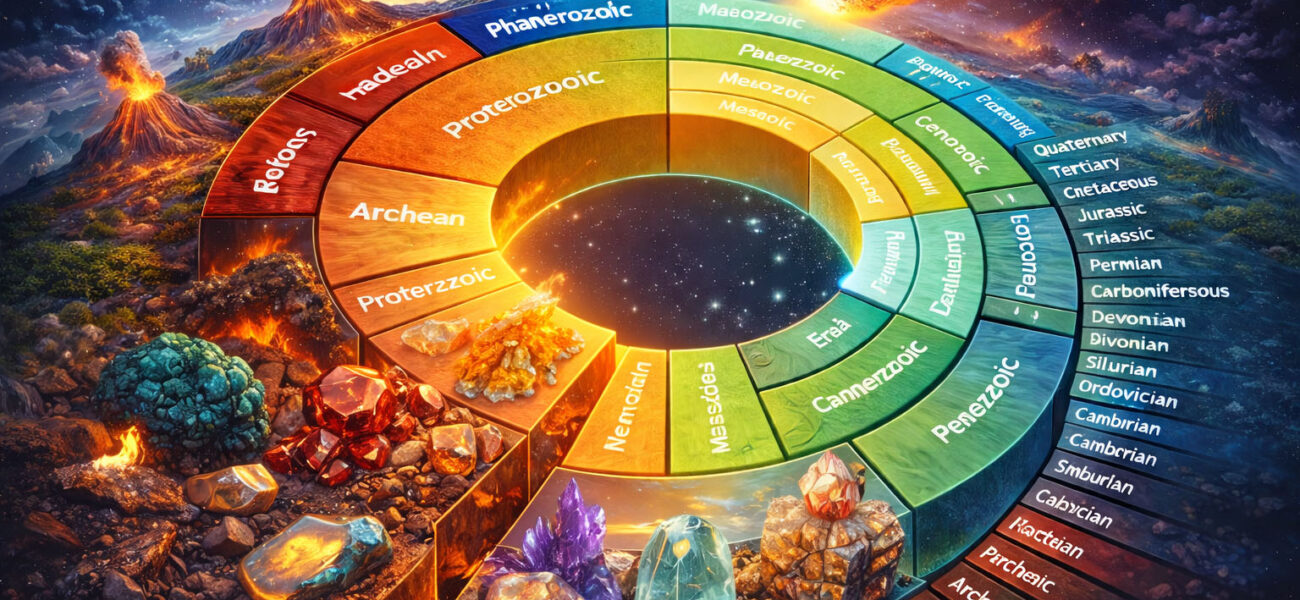
The geologic time scale is a framework used to organize Earth’s 4.5+ billion year history into manageable segments based on major changes in geology, climate, and life. Rather than being arbitrary divisions, these intervals are tied to observable shifts in the rock record—often marked by the appearance or disappearance of fossil groups, changes in sediment types, or global events like mass extinctions.
For collectors and field geologists, the time scale is not just an abstract chart. It directly influences what minerals, fossils, and rock types you are likely to encounter in a given formation.
How the Time Scale Is Structured
Earth’s history is divided hierarchically into eons, eras, periods, epochs, and ages. The boundaries between these divisions are defined by specific markers in rock layers, known as stratigraphic boundaries.
- Eons are the largest divisions. There are four: Hadean, Archean, Proterozoic, and Phanerozoic.
- Eras subdivide eons and reflect broad biological and geological shifts.
- Periods are more detailed divisions often associated with distinct fossil assemblages.
In practice, most rockhounds encounter terms like “Jurassic,” “Devonian,” or “Cambrian” because these periods correspond to rock units commonly exposed at the surface.
Reading Time in the Rock Record
The geologic time scale is built from stratigraphy—the study of layered rocks. Sedimentary layers accumulate over time, with older layers generally found beneath younger ones. However, this simple principle is often complicated by folding, faulting, and erosion.
In the field, time is not measured directly but inferred from:
- Fossils (biostratigraphy)
- Radiometric dating of minerals
- Correlation between rock units across regions
For example, a shale layer containing trilobite fossils is typically assigned to the Paleozoic Era, most commonly Cambrian or Ordovician in age. The presence of certain trilobite species can narrow that range even further.
Precambrian Time: The Mineral-Heavy Record
The first three eons—Hadean, Archean, and Proterozoic—are collectively referred to as the Precambrian. This spans nearly 90% of Earth’s history.
From a mineral perspective, Precambrian rocks are often the most rewarding for collectors. They include:
- Banded iron formations (hematite and magnetite layers)
- Ancient metamorphic rocks rich in garnet, kyanite, and staurolite
- Pegmatites containing large crystals of feldspar, quartz, and rare minerals
Fossils are rare in these rocks, so time divisions are based more on radiometric dating than biological markers. When you find a coarse-grained pegmatite with meter-scale feldspar crystals, there is a strong chance it formed deep in the Precambrian.
The Phanerozoic Eon: Fossils and Changing Environments
The Phanerozoic Eon (about 541 million years ago to present) is where the fossil record becomes abundant and detailed. It is divided into three eras:
- Paleozoic
- Mesozoic
- Cenozoic
Each reflects major shifts in life and depositional environments, which directly affect the types of rocks and minerals found.
Paleozoic Era: Marine Dominance and Early Land Life
The Paleozoic is characterized by widespread shallow seas. Many sedimentary rocks from this era—limestones, shales, and sandstones—are fossil-rich.
Common field observations include:
- Limestone packed with crinoid fragments (often weathering into granular debris)
- Brachiopod shells preserved in shale
- Trilobite fragments in fine-grained sedimentary rocks
Mineral collectors may also encounter sulfide deposits formed in marine environments, such as pyrite nodules in Devonian or Mississippian shales.
Coal deposits from the late Paleozoic (Carboniferous Period) are another important feature. These formed from dense swamp vegetation and are often associated with ironstone concretions and fossil plant material.
Mesozoic Era: Reptiles and Red Beds
The Mesozoic is often associated with dinosaurs, but from a rockhounding perspective, it is notable for extensive continental deposits.
Many Mesozoic formations are “red beds”—sedimentary rocks colored by iron oxides. These environments were typically arid or semi-arid.
Typical observations include:
- Sandstones stained red or orange by hematite
- Evaporite minerals like gypsum forming in restricted basins
- Petrified wood in fluvial (river) deposits
The mineral composition of these rocks often reflects oxidation conditions. Iron is commonly present as hematite rather than magnetite, giving the rocks their characteristic color.
Cenozoic Era: Modern Landscapes and Volcanism
The Cenozoic represents the last 66 million years and includes the development of modern ecosystems and landscapes.
For collectors, this era is often associated with:
- Volcanic rocks such as basalt and rhyolite
- Hydrothermal mineral deposits (quartz veins, opal, chalcedony)
- Fossils that closely resemble modern species
In volcanic regions, minerals like olivine, pyroxene, and feldspar are common in basalt flows. Vesicular basalt may contain secondary minerals such as zeolites or calcite crystals filling gas bubbles.
Younger sedimentary deposits may also contain well-preserved fossils, including shells, bones, and even plant material.
How Boundaries Are Defined
The boundaries between time intervals are not evenly spaced. Many are defined by significant global events.
For example:
- The boundary between the Permian and Triassic periods marks the largest known mass extinction.
- The Cretaceous–Paleogene boundary is associated with the extinction of non-avian dinosaurs.
These boundaries are often identified in the rock record by abrupt changes in fossil content or unusual geochemical signatures, such as elevated iridium levels.
For collectors, this means that certain layers may show a sharp transition—from fossil-rich limestone to nearly barren clay, for instance.
Why the Time Scale Matters in the Field
Understanding the geologic time scale allows you to predict what you might find before you even arrive at a site.
If a map indicates Ordovician limestone, you can reasonably expect:
- Marine fossils such as brachiopods and cephalopods
- Calcite-rich rock that reacts with acid
- Occasional chert nodules
If the area is mapped as Precambrian metamorphic terrain, fossils are unlikely, but mineral diversity may be high.
Even subtle differences matter. Devonian shale may contain different fossil assemblages than Silurian shale, despite appearing similar at first glance.
Limitations and Uncertainty
The geologic time scale is continually refined. New radiometric dates, fossil discoveries, and stratigraphic studies can shift boundaries or reclassify intervals.
In some regions, rock units are difficult to date precisely due to:
- Lack of fossils
- Metamorphism altering original features
- Complex structural history
As a result, age assignments may be approximate. Field guides and geological maps often reflect the best available interpretation, but they are not always definitive.
A Practical Perspective
For most rockhounds, the geologic time scale becomes intuitive with experience. Instead of memorizing dates, it is more useful to associate time intervals with:
- Typical rock types
- Common fossils
- Characteristic mineral assemblages
Over time, a glance at a weathered outcrop—its color, grain size, and fossil content—can provide a reasonable estimate of its place in Earth’s history.