Crystals form when atoms arrange themselves into an orderly, repeating pattern. This process, called crystallization, can happen in several different environments, but the underlying principle is the same: atoms bond in a structured way that minimizes energy under specific physical conditions. For collectors, the visible shape of a crystal is only the outer expression of […]
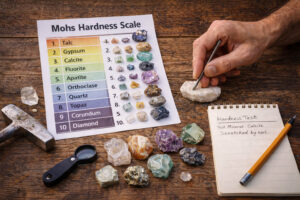
The Mohs Hardness Scale, What is It and Why is It Useful
The Mohs hardness scale is one of the simplest tools used to identify minerals, but it is often misunderstood. It ranks minerals based on their resistance to scratching, not their overall strength or durability. Developed in 1812 by Friedrich Mohs, the scale runs from 1 (very soft) to 10 (very hard), using ten reference minerals. […]
Rocks vs. Minerals: How to Tell the Difference in the Field
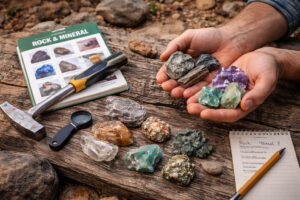
The distinction between rocks and minerals is fundamental in geology, but it is often misunderstood outside of academic settings. In practical terms, a mineral is a single, naturally occurring substance with a defined chemical composition and crystal structure. A rock, by contrast, is an aggregate—made up of one or more minerals (and sometimes non-mineral material). […]
Rockhounding in U.S. National Parks: What’s Allowed, What Isn’t, and Why It Matters
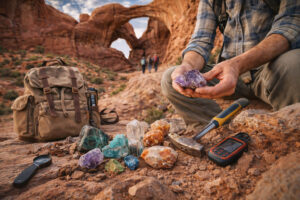
Collectors often assume that public land means open access for collecting. That is not the case in U.S. National Parks. The National Park Service (NPS) operates under a preservation-first mandate, and that directly affects what you can and cannot do with rocks, minerals, and fossils inside park boundaries. Understanding these rules is not just about […]
Geologic Time Scale Explained
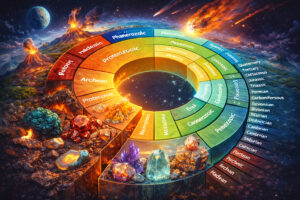
The geologic time scale is a framework used to organize Earth’s 4.5+ billion year history into manageable segments based on major changes in geology, climate, and life. Rather than being arbitrary divisions, these intervals are tied to observable shifts in the rock record—often marked by the appearance or disappearance of fossil groups, changes in sediment […]