
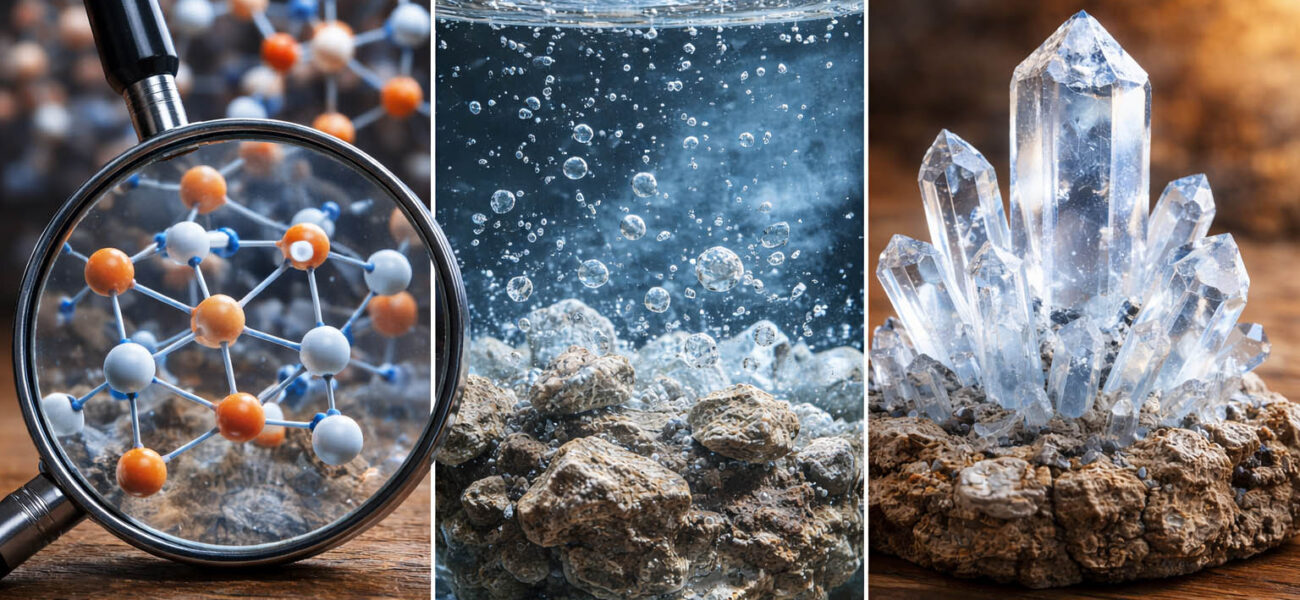
Crystals form when atoms arrange themselves into an orderly, repeating pattern. This process, called crystallization, can happen in several different environments, but the underlying principle is the same: atoms bond in a structured way that minimizes energy under specific physical conditions.
For collectors, the visible shape of a crystal is only the outer expression of that internal structure. The conditions during growth determine whether a mineral forms well-defined crystals, massive aggregates, or something in between.
The Role of Atomic Arrangement
At the most basic level, a crystal is defined by its internal lattice, a repeating three-dimensional pattern of atoms or ions. This structure controls everything from crystal shape to hardness and cleavage.
Quartz, for example, forms a hexagonal crystal system because its silicon and oxygen atoms bond in a specific repeating arrangement. Even when quartz appears as a massive, non-crystalline lump, that internal structure is still present.
This is why broken pieces of quartz still show conchoidal fracture rather than flat cleavage planes, the atomic bonds are strong and evenly distributed in all directions.
Crystallization from Magma
One of the most common ways crystals form is through the cooling of molten rock. As magma cools, atoms slow down and begin to bond into stable mineral structures.
The rate of cooling has a direct impact on crystal size:
- Slow cooling (deep underground): large, well-formed crystals
- Rapid cooling (at or near the surface): small or microscopic crystals
Granite is a clear example of slow cooling. Its visible grains of quartz, feldspar, and mica formed over long periods, allowing crystals to grow large enough to be seen with the naked eye.
In contrast, basalt cools quickly, so its minerals are typically fine-grained. Individual crystals may be difficult to distinguish without magnification.
In some cases, cooling conditions change. Pegmatites, often associated with granitic systems, form during the final stages of magma crystallization. These environments allow unusually large crystals to develop, including meter-scale feldspar and quartz.
Crystallization from Solutions
Crystals can also form from liquids, especially water carrying dissolved minerals. As conditions change, such as evaporation, temperature shifts, or pressure drops, the solution can no longer hold all the dissolved material, and minerals begin to crystallize.
This process is common in:
- Hydrothermal veins
- Evaporite deposits
- Cave formations
In hydrothermal systems, hot fluids move through fractures in rock, depositing minerals as they cool. Quartz veins are a typical result. You may find well-formed quartz crystals lining cavities where there was open space for growth.
In evaporite environments, minerals like halite (rock salt) and gypsum crystallize as water evaporates. Halite often forms cubic crystals, reflecting its internal structure.
A practical observation: halite crystals in an undisturbed evaporite layer tend to show sharp edges and clear cubic forms. In contrast, halite exposed to moisture may become rounded or dissolve partially, losing its original shape.
Growth in Open Space vs. Confined Environments
Crystal shape depends heavily on whether there is room to grow.
- Open space: crystals develop well-defined faces (euhedral crystals)
- Crowded conditions: crystals grow into each other, forming irregular shapes (anhedral or subhedral)
Geodes are a good example of open-space growth. Inside the cavity, crystals have space to form outward from the walls, often resulting in symmetrical, well-terminated points.
In a dense rock like granite, minerals crystallize simultaneously and compete for space. The result is interlocking grains rather than distinct crystal forms.
This difference is often obvious when comparing a quartz crystal cluster from a geode to the quartz grains in a piece of granite.
Temperature and Pressure Influence
Different minerals form under specific ranges of temperature and pressure. These conditions determine which crystal structures are stable.
For example:
- Graphite and diamond are both forms of carbon, but diamond forms under much higher pressure.
- Kyanite, andalusite, and sillimanite share the same chemical composition but form under different temperature-pressure conditions.
In metamorphic rocks, these conditions can produce crystals that reflect the environment of formation. Garnet crystals in schist often grow during metamorphism, sometimes enclosing smaller mineral grains as they expand.
A field observation: garnet crystals in metamorphic rocks often appear as rounded or dodecahedral shapes embedded in a foliated matrix. Their growth can disrupt the surrounding layers, creating visible distortion.
Supersaturation and Nucleation
For crystals to form from a liquid, the solution must reach a state called supersaturation, where it contains more dissolved material than it can normally hold.
At that point, nucleation begins. This is the initial formation of tiny clusters of atoms that act as starting points for crystal growth.
Nucleation can occur:
- On existing surfaces (such as rock walls or impurities)
- Spontaneously within the solution
The number of nucleation sites affects crystal size. Many nucleation points lead to numerous small crystals. Fewer nucleation points allow larger crystals to develop.
This is why some quartz veins contain tightly packed small crystals, while others produce larger, well-spaced specimens.
Impurities and Color Variations
Trace elements and defects in the crystal structure can affect color and appearance.
Examples include:
- Amethyst: purple color from iron impurities and radiation exposure
- Smoky quartz: color caused by natural irradiation affecting the crystal lattice
- Fluorite: wide range of colors due to various impurities
These variations do not change the underlying crystal structure but can influence how a specimen is identified or valued.
In some cases, color zoning occurs, where different parts of a crystal show distinct रंग bands. This reflects changes in the growth environment during formation.
Interrupted Growth and Secondary Changes
Crystal formation is not always continuous. Changes in conditions can interrupt growth or alter existing crystals.
Common features include:
- Overgrowths: new layers forming on older crystals
- Dissolution surfaces: partial re-dissolving of crystal faces
- Inclusions: other minerals trapped during growth
Quartz crystals with phantom inclusions, faint outlines of earlier growth stages, are a clear example. These form when growth pauses, a thin layer of impurities settles, and then growth resumes.
In hydrothermal systems, minerals may form in stages, leading to layered deposits or multiple generations of crystals within the same vein.
Why Crystal Formation Varies So Widely
Even within the same mineral species, crystal form can vary dramatically depending on conditions.
Quartz alone can appear as:
- Large, well-formed hexagonal crystals in open cavities
- Fine-grained masses in sandstone
- Fibrous aggregates in chalcedony
These differences are not due to changes in chemical composition but to differences in how and where the crystals formed.
A Field-Based Perspective
For collectors, recognizing how crystals form helps explain what you see in a specimen.
A cluster of quartz points inside a geode indicates growth into open space. Interlocking feldspar and quartz grains in granite point to slow cooling underground. A vein cutting across rock layers suggests mineral deposition from fluids.
Rather than viewing crystals as isolated objects, understanding their formation connects them to the larger geological processes that created them.