
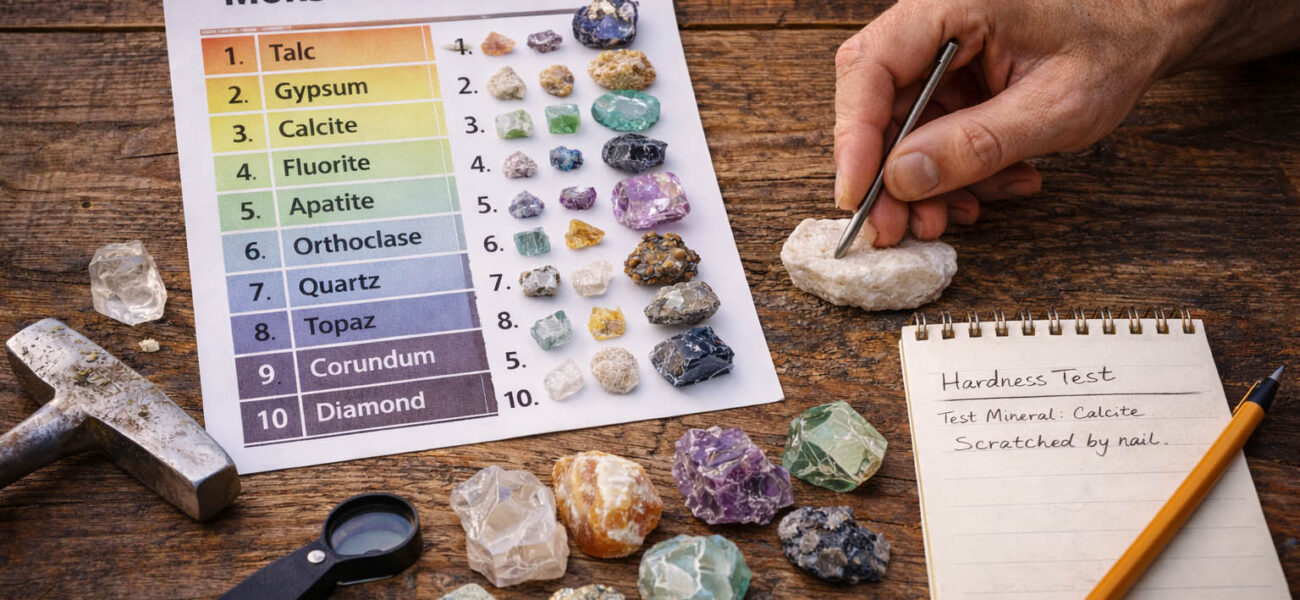
The Mohs hardness scale is one of the simplest tools used to identify minerals, but it is often misunderstood. It ranks minerals based on their resistance to scratching, not their overall strength or durability. Developed in 1812 by Friedrich Mohs, the scale runs from 1 (very soft) to 10 (very hard), using ten reference minerals.
For collectors, the value of the scale is practical. It helps narrow down mineral identification quickly using simple scratch tests, often without specialized equipment.
The Scale and Its Reference Minerals
The Mohs scale is relative, not linear. Each step represents a mineral that can scratch those below it and be scratched by those above it.
The standard sequence is:
- Talc
- Gypsum
- Calcite
- Fluorite
- Apatite
- Orthoclase feldspar
- Quartz
- Topaz
- Corundum
- Diamond
A key point is that the difference in hardness between numbers is not equal. Quartz (7) is significantly harder than orthoclase (6), but diamond (10) is far harder than corundum (9), by a much larger margin than the scale suggests.
What “Hardness” Means in This Context
Hardness here refers specifically to scratch resistance. It does not measure how easily a mineral breaks, chips, or shatters.
For example:
- Diamond is extremely hard but can fracture if struck correctly.
- Calcite (hardness 3) scratches easily but can still form solid, durable rock masses.
- Pyrite is harder than many common minerals but can crumble along crystal boundaries.
This distinction matters when evaluating specimens. A mineral that resists scratching may still be fragile under pressure.
Simple Field Testing
Rockhounds rarely carry a full set of reference minerals. Instead, common objects are used as rough hardness guides:
- Fingernail: ~2.5
- Copper coin: ~3
- Knife blade or steel: ~5–5.5
- Glass: ~5.5
- Quartz (if available): 7
These comparisons allow for quick testing. For instance, if a mineral scratches glass but is scratched by quartz, it likely falls between 6 and 7.
A common field observation: calcite (3) will not scratch a copper coin but will be easily scratched by one. Quartz, on the other hand, will leave a clear scratch on glass and remain unaffected.
Observations in Common Minerals
Hardness is often tied to how minerals behave during weathering and transport.
- Quartz (7) persists in sediments because it resists abrasion. This is why many sandstones are quartz-rich.
- Feldspar (6) breaks down more readily, often altering into clay minerals.
- Softer minerals like gypsum (2) rarely survive long transport and are more often found in place, such as in evaporite deposits.
In stream beds, harder minerals tend to dominate because softer ones have already worn away. This is one reason quartz pebbles are so common in river gravel.
Scratching vs. Streaking
Scratch testing should not be confused with streak testing. Streak refers to the color of a mineral’s مسحوق when rubbed on a porcelain plate, while hardness is about resistance to being scratched.
It is also important to distinguish between scratching a mineral and leaving a mark. Some minerals, like hematite, can leave a streak that looks like a scratch but is actually powder residue.
A true scratch involves cutting into the surface, which can usually be felt with a fingernail.
Limitations of the Mohs Scale
While useful, the Mohs scale has limitations:
- It provides only relative values, not precise measurements
- It does not account for directional hardness (some minerals scratch more easily along certain planes)
- Surface weathering can alter apparent hardness
For example, a weathered feldspar surface may appear softer due to alteration into clay, even though fresh feldspar is harder. Similarly, minerals with cleavage planes may scratch more easily along those planes.
Because of this, multiple tests and observations are usually needed for reliable identification.
Hardness and Crystal Structure
The hardness of a mineral is closely tied to how its atoms are bonded.
- Strong, tightly bonded structures (like quartz) result in higher hardness
- Weakly bonded layers (like talc) result in low hardness
Talc, for example, has a layered structure that allows sheets to slide over each other easily, which is why it feels greasy and scratches so easily. Quartz, with its three-dimensional network of strong bonds, resists scratching much more effectively.
This structural difference becomes obvious when handling specimens. Talc can often be scratched with a fingernail, while quartz will resist steel tools.
Why the Scale Still Matters
Despite being over 200 years old, the Mohs scale remains widely used because it is simple and practical. It allows for quick comparisons without laboratory equipment.
In the field, hardness is often one of the first properties tested, alongside color, luster, and cleavage. It helps eliminate possibilities early in the identification process.
For example, if a clear mineral scratches glass, it is unlikely to be calcite (hardness 3) and more likely to be quartz (7) or a similar mineral.
A Practical Approach for Collectors
Rather than memorizing all ten reference minerals, it is more useful to remember a few key points:
- Anything that scratches glass is above ~5.5
- Quartz (7) is a common benchmark for harder minerals
- Fingernail and coin tests quickly identify very soft minerals
Over time, repeated handling of specimens builds an intuitive sense of hardness. A collector may recognize that a mineral “feels” harder or softer based on how it responds to light pressure or contact with tools.
Field Reality
In real conditions, hardness testing is often combined with other observations. A mineral’s environment, associated minerals, and overall appearance all contribute to identification.
For instance, a translucent mineral found in a vein cutting through granite that scratches glass is more likely to be quartz than a less common alternative. The hardness test supports that conclusion but is not the only factor.
Used correctly, the Mohs hardness scale is less about exact numbers and more about narrowing possibilities. It remains one of the most accessible and reliable tools for understanding minerals in the field.