
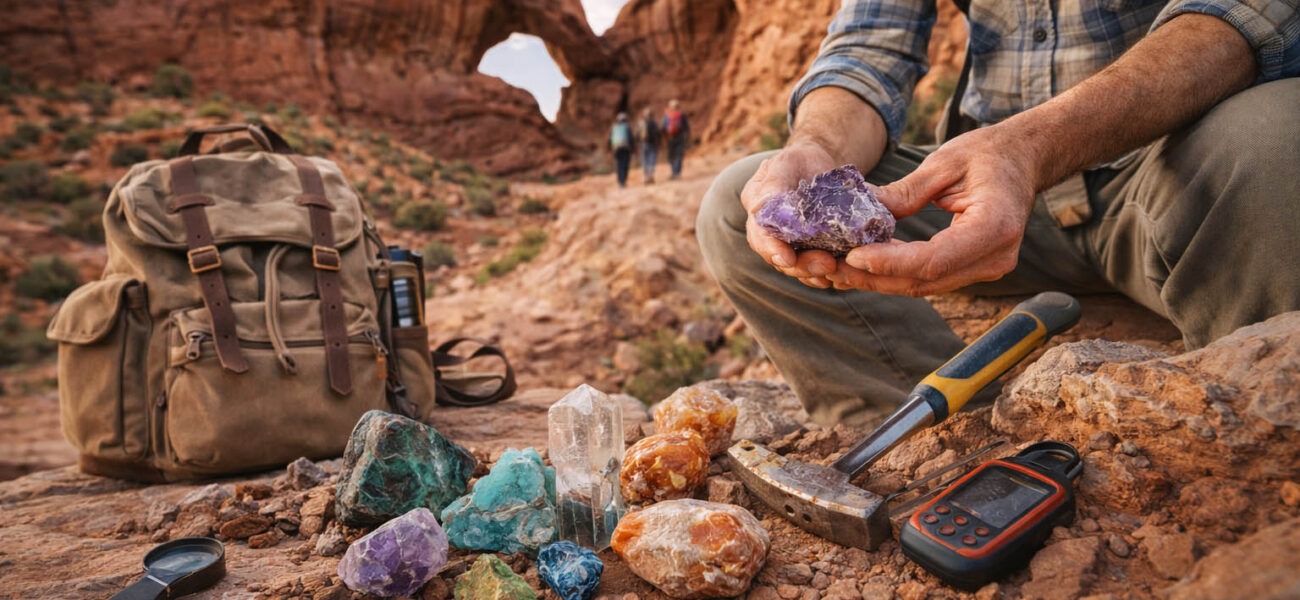
Collectors often assume that public land means open access for collecting. That is not the case in U.S. National Parks. The National Park Service (NPS) operates under a preservation-first mandate, and that directly affects what you can and cannot do with rocks, minerals, and fossils inside park boundaries.
Understanding these rules is not just about avoiding fines. It also helps explain why certain formations remain intact, and why some of the most famous mineral and fossil localities are no longer accessible to collectors.
The Core Rule: No Collecting
In National Parks, the general rule is simple:
You cannot remove rocks, minerals, fossils, or other natural materials.
This applies regardless of size, value, or abundance. Even loose gravel, a small quartz crystal, or a fossil fragment found on the ground is protected. The restriction is enforced under federal law, including regulations tied to the Organic Act of 1916 and subsequent resource protection policies.
From a geological perspective, this rule preserves context. A fossil embedded in a layer of shale tells a different story than the same fossil removed and placed in a collection. Once removed, its stratigraphic position, and therefore its scientific value, is lost.
What You Can Do Instead
While collecting is prohibited, observation is encouraged. Many parks are exceptional places to study geology in the field without disturbing it.
Visitors are allowed to:
- Examine rocks and minerals in place
- Photograph outcrops, crystals, and fossil exposures
- Sketch or document formations
- Use hand lenses or field notebooks for study
For example, in a park with exposed pegmatites, you might observe feldspar crystals several inches across, intergrown with quartz and mica. You can document their size, orientation, and weathering patterns, but you cannot extract even a small fragment.
Why the Rules Are Strict
The restrictions are not arbitrary. They are based on long-term impacts observed over decades.
In high-traffic areas, even small-scale collecting can quickly degrade a site. A vein of quartz exposed along a trail may appear abundant, but repeated removal by visitors can strip it down to a featureless surface within a few seasons.
Fossil sites are particularly vulnerable. A shale slope containing trilobite impressions may look like loose debris, but removing pieces disrupts the distribution of fossils that researchers use to interpret ancient environments.
In some parks, iron oxide–rich formations weather into distinctive colors and patterns. Removing pieces alters the visual landscape, which is considered part of the resource being protected.
Differences from Other Public Lands
The rules in National Parks are stricter than in many other federally managed lands.
- Bureau of Land Management (BLM) land: Limited recreational collecting is often allowed, especially for common minerals and rocks.
- U.S. Forest Service land: Rules vary, but small-scale collecting is frequently permitted with restrictions.
- National Parks: No recreational collecting of rocks, minerals, or fossils.
This distinction is important for planning trips. A region may have excellent geology both inside and outside park boundaries, but only the areas outside the park may allow collecting.
Fossils: An Even Higher Level of Protection
Fossils receive special attention under federal law. In National Parks, all fossils, vertebrate and invertebrate, are protected.
Even common fossils, such as brachiopods or crinoid stems, cannot be collected. This surprises many visitors who are used to finding similar material on road cuts or private land.
The reason is partly scientific. Fossil assemblages are used to define geologic time intervals and environmental conditions. Removing specimens disrupts that dataset, even if the individual fossils seem abundant.
Surface vs. Embedded Material
A common misconception is that only embedded material is protected. In reality, the rule applies to both:
- Rocks still attached to bedrock
- Loose fragments on the ground
- Float material that has weathered out of its original layer
For example, if a chunk of chert containing fossil fragments has rolled down a slope, it is still protected. Its position relative to the source layer can still provide useful information.
Penalties and Enforcement
Violating National Park regulations can result in fines, confiscation of materials, and in some cases criminal charges. Enforcement varies by park, but rangers do monitor collecting activity, particularly in known fossil or mineral areas.
Collectors have been cited for removing items as small as pocket-sized rocks. The size or perceived value of the specimen does not determine whether it is protected.
Permits for Scientific Collection
There are limited exceptions for scientific research. Qualified researchers can apply for permits to collect samples for study.
These permits are:
- Highly regulated
- Issued only for specific research purposes
- Often require documentation, reporting, and curation of collected material
This system allows scientific work to continue while preventing casual removal of resources.
Field Observations Without Collecting
For rockhounds used to bringing specimens home, National Parks require a different approach. Instead of collecting, focus shifts to careful observation.
Some practical approaches include:
- Noting mineral associations (e.g., quartz veins cutting through metamorphic rock)
- Observing weathering patterns (such as how feldspar breaks down into clay minerals)
- Identifying fossil types and their distribution within a layer
- Recording color variations tied to oxidation states (red hematite vs. gray reduced iron)
In volcanic areas, you might examine vesicular basalt and note which cavities contain secondary minerals like calcite or zeolites. While you cannot collect them, you can still study how they formed.
Planning a Trip as a Collector
If your goal is to collect specimens, National Parks are not the right destination. However, they can still be valuable for:
- Learning to identify formations in place
- Understanding large-scale geologic structures
- Seeing examples of minerals and rocks in their natural context
Before heading out, it is worth checking maps for nearby areas managed by the BLM or Forest Service where collecting may be allowed.
Why These Areas Remain Valuable
Because collecting is prohibited, many National Parks preserve geological features that have been heavily depleted elsewhere.
Quartz veins remain intact. Fossil beds are undisturbed. Fragile mineral coatings, such as desert varnish, are preserved across large surfaces rather than chipped away.
For collectors, this can be frustrating in the moment. But over time, it provides something increasingly rare: a chance to see geological features as they exist in place, rather than as isolated specimens.
Understanding and respecting these rules helps ensure that these exposures remain available for study, photography, and future research.