
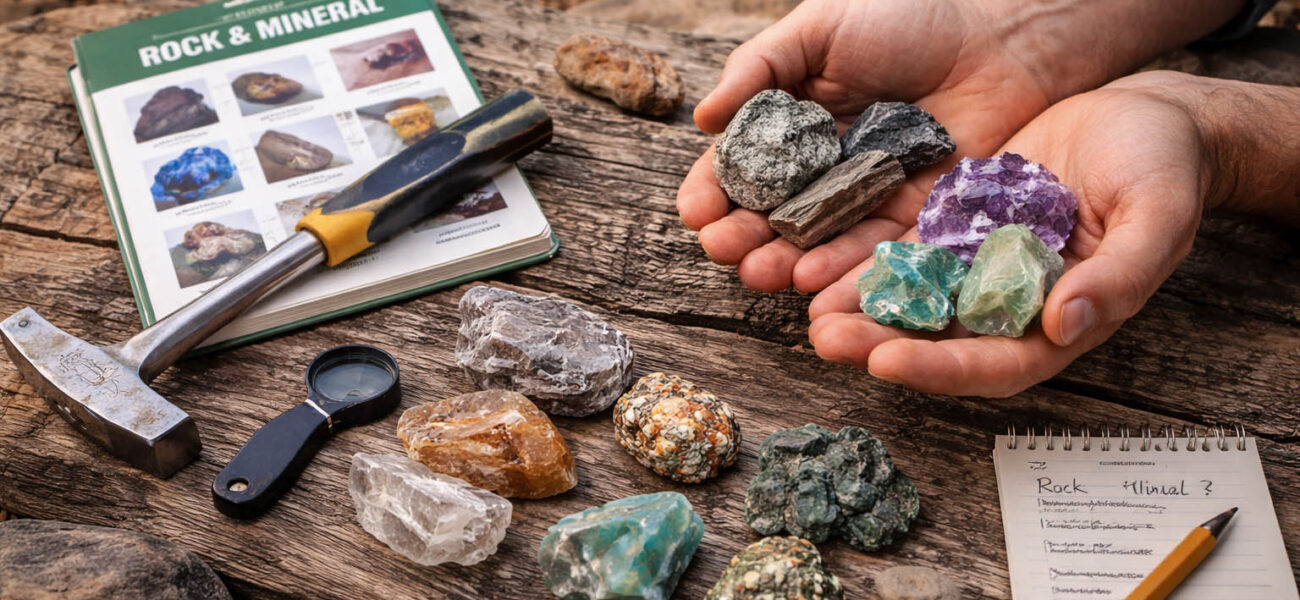
The distinction between rocks and minerals is fundamental in geology, but it is often misunderstood outside of academic settings. In practical terms, a mineral is a single, naturally occurring substance with a defined chemical composition and crystal structure. A rock, by contrast, is an aggregate—made up of one or more minerals (and sometimes non-mineral material).
This difference becomes clearer when you’re looking at actual specimens rather than definitions.
Minerals: Consistent Composition and Structure
A mineral is defined by two key characteristics:
- A specific chemical formula (or a limited range of variation)
- A repeating internal crystal structure
Quartz is a useful example. Whether it appears as a clear crystal, milky mass, or purple amethyst, it is still silicon dioxide (SiO₂) with the same internal arrangement of atoms. That structure is what produces its consistent hardness (7 on the Mohs scale) and conchoidal fracture.
In the field, minerals often show:
- Distinct crystal faces or geometric shapes
- Uniform physical properties across a sample
- Predictable cleavage or fracture patterns
Calcite, for instance, consistently breaks along three directions to form rhombohedral fragments. Even when weathered, this cleavage can often still be recognized.
Rocks: Mixtures with Variable Composition
A rock is made up of one or more minerals, and sometimes additional materials like organic matter or volcanic glass. The composition can vary significantly, even within the same rock type.
Granite is a classic example. It typically contains:
- Quartz (gray or translucent grains)
- Feldspar (often pink, white, or cream-colored)
- Mica (black biotite or silvery muscovite flakes)
Each of these minerals retains its own properties, but together they form a cohesive rock. If you look closely at a piece of granite, you can usually distinguish individual mineral grains with the naked eye.
In contrast, basalt is also a rock but has a much finer grain size. Its minerals—primarily plagioclase feldspar and pyroxene—are often too small to see without magnification. This difference in texture reflects how the rock formed, not a change in the definition.
Single-Mineral Rocks
Some rocks are composed almost entirely of one mineral, which can blur the distinction.
Examples include:
- Marble: mostly calcite
- Quartzite: mostly quartz
- Limestone: often predominantly calcite
Even in these cases, the material is still considered a rock because it formed as an aggregate. Marble, for example, consists of interlocking calcite crystals that recrystallized under heat and pressure. While it may appear uniform, it is not a single crystal.
A key observation is that breaking a piece of marble does not produce clean calcite crystal forms—it produces a mass of intergrown grains.
Texture: A Practical Clue
One of the most useful ways to distinguish rocks from minerals in the field is texture.
Minerals tend to show:
- Smooth crystal faces
- Consistent internal structure
- Repeating geometric forms
Rocks tend to show:
- Mixed grain sizes or compositions
- Boundaries between different minerals
- Layering, banding, or vesicles
For example, a banded gneiss will show alternating layers of light and dark minerals. Each layer reflects a concentration of different mineral groups, which is not something you see in a single mineral specimen.
Formation Processes Matter
Minerals form through processes such as crystallization from magma, precipitation from fluids, or metamorphic reactions. Each mineral represents a stable arrangement of elements under specific conditions.
Rocks form through broader geological processes:
- Igneous rocks form from cooled magma or lava
- Sedimentary rocks form from accumulated particles or chemical precipitation
- Metamorphic rocks form when existing rocks are altered by heat and pressure
Because rocks are products of these processes, they often preserve evidence of their formation. Vesicles in basalt indicate trapped gas bubbles. Rounded grains in sandstone suggest transport by water or wind. Foliation in schist reflects alignment of minerals under الضغط.
Weathering and Breakdown
Another practical difference shows up during weathering.
Minerals break down according to their individual stability. Feldspar, for example, often alters into clay minerals. Quartz is more resistant and tends to persist as sand grains.
Rocks weather as a combination of these processes. In a granite outcrop, you might see feldspar grains softening and turning chalky while quartz grains remain hard and intact. Over time, the rock disaggregates into its mineral components.
This is why sandy soils are often rich in quartz, even if the original rock contained a mix of minerals.
Why the Distinction Matters for Collectors
For collectors, knowing whether you’re looking at a mineral or a rock affects how you identify and categorize specimens.
If you find a well-formed crystal with consistent properties throughout, you are likely dealing with a mineral specimen. If the sample contains multiple components or shows textural variation, it is a rock.
This also influences value and classification. A quartz crystal cluster is typically considered a mineral specimen. A piece of granite, even if visually appealing, is classified as a rock specimen unless it contains notable mineral features.
Edge Cases and Common Confusion
Certain materials fall outside strict definitions or create confusion:
- Obsidian: a volcanic glass, technically not a mineral because it lacks a crystal structure
- Coal: an organic rock derived from plant material
- Mineraloids: substances like opal that lack a defined crystal structure
These exceptions highlight that the definitions are based on structure and composition, not just appearance.
Field Perspective
In practice, the distinction becomes intuitive with experience. A quick visual and tactile inspection—looking at grain size, uniformity, and structure—usually provides enough information.
A vein of quartz cutting through a host rock is a clear example: the quartz is the mineral, and the surrounding material is the rock. The contrast between the two often makes identification straightforward.
Over time, recognizing these differences helps in everything from mapping outcrops to selecting specimens worth collecting or studying more closely.